VALORANT Cheats Explained: Types, Risks, and Vanguard’s Detection System
Last Updated: July 2026
The term VALORANT cheats is frequently searched by players who want to understand unauthorized software, suspicious gameplay, account penalties, anti-cheat technology, and the cybersecurity risks associated with unofficial downloads.
Related expressions such as VALORANT cheat, VALORANT hack, VALORANT hacks, VALORANT aimbot, and VALORANT wallhack also appear regularly in discussions about competitive integrity and Riot Vanguard.
An educational overview of VALORANT cheats, common cheat categories, cybersecurity risks, potential penalties, and Riot Vanguard detection methods.

This article explains what VALORANT cheats generally are, which unauthorized software categories are commonly discussed, why such tools are prohibited, what risks they create, and how Riot Vanguard helps protect competitive gameplay.
The content is provided exclusively for educational and informational purposes. It does not promote, sell, distribute, recommend, or facilitate unauthorized software.
What Are VALORANT Cheats?
VALORANT cheats generally refer to unauthorized third-party software, scripts, drivers, overlays, modifications, or automated tools designed to interfere with normal gameplay.
Their purpose is usually to provide an advantage unavailable to legitimate players. This may involve aiming assistance, access to hidden information, automated actions, recoil control, radar information, or manipulation of game-related processes.
Regardless of the method, unauthorized gameplay modifications can undermine competitive fairness and may result in account enforcement.
VALORANT Cheat vs. VALORANT Hack
The words cheat and hack are often used interchangeably in gaming communities. However, they may have slightly different meanings depending on the context.
- Cheat: Usually refers to software or behavior that creates an unfair gameplay advantage.
- Hack: A broader term that may refer to unauthorized modification, manipulation, or software interference.
In everyday gaming discussions, searches for VALORANT cheat and VALORANT hack often lead to similar content involving aimbots, wallhacks, ESP overlays, triggerbots, radar tools, and anti-cheat detection.
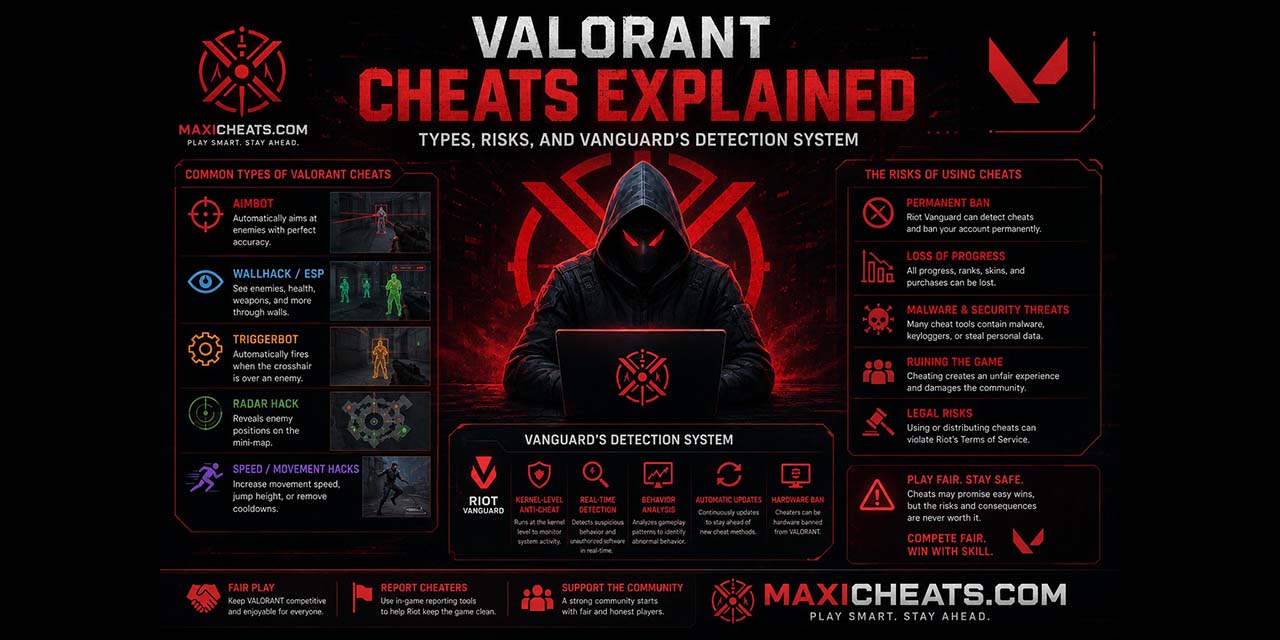
Common Types of VALORANT Cheats
Unauthorized gaming software may be described using several different names. The following categories are among the most commonly discussed.
VALORANT Aimbot
A VALORANT aimbot generally refers to unauthorized software that attempts to automate, influence, or assist aiming behavior.
Instead of relying entirely on reaction time, crosshair placement, target tracking, mouse movement, and mechanical skill, an aimbot may attempt to guide the crosshair toward an opponent.
Because precise aiming is one of the central skills in VALORANT, unauthorized aim assistance can create a direct combat advantage.
VALORANT Wallhack
A VALORANT wallhack generally describes unauthorized software that attempts to reveal player positions or information that should remain hidden.
Map knowledge, sound awareness, positioning, communication, utility usage, and timing are essential parts of competitive gameplay. A wallhack may undermine these mechanics by exposing information without requiring legitimate observation.
ESP
ESP is commonly used in gaming terminology to describe unauthorized overlays that attempt to display additional information beyond the normal game interface.
Information associated with ESP may include:
- Player positions
- Distance indicators
- Health information
- Equipment information
- Directional markers
- Object or location information
ESP is often grouped together with wallhack software because both attempt to provide information that legitimate players should not possess.
Triggerbot
A triggerbot generally refers to unauthorized software that attempts to activate firing when specific conditions are detected.
Unlike an aimbot, which may influence crosshair movement, a triggerbot is usually associated with automated timing and reaction behavior.
Radar Cheats
Radar-related cheats attempt to provide positional information through a secondary interface or display outside the standard game environment.
Such tools may provide additional awareness of opponent locations or movement, creating an unauthorized information advantage.
Recoil Automation
Recoil-related tools may attempt to automate or compensate for weapon movement. This can reduce the need for normal mouse control and mechanical practice.
Movement or Input Automation
Some unauthorized tools may attempt to automate movement patterns, repeated actions, firing sequences, or other forms of player input.
Any software that replaces normal player input or alters expected gameplay behavior may be considered prohibited.
Why Are VALORANT Cheats Prohibited?
Competitive games depend on every participant operating under the same technical rules and gameplay limitations. Unauthorized software disrupts that balance.
They Create Unfair Advantages
Aimbots, wallhacks, ESP overlays, triggerbots, radar tools, and automation can provide advantages that legitimate players do not have.
They Damage Ranked Integrity
Ranked systems are intended to measure performance based on skill, communication, decision-making, strategy, consistency, and teamwork.
Unauthorized tools can distort match results and affect the ranking progress of both the user and other players.
They Reduce Player Trust
When players believe that matches may be influenced by cheats or hacks, confidence in matchmaking, rankings, tournament results, and competitive systems can decline.
They Violate Platform Rules
Using unauthorized software may violate Riot Games' applicable agreements, policies, and competitive rules.
What Is Riot Vanguard?
Riot Vanguard is the anti-cheat system used to help protect VALORANT. It is designed to identify unauthorized software, suspicious interference, and activity that may threaten competitive integrity.
Vanguard includes application-level and system-level security components. Its full detection methods are not publicly disclosed because revealing every technical mechanism could help unauthorized software developers attempt to avoid detection.
How Does Riot Vanguard Detect VALORANT Cheats?
Modern anti-cheat systems generally use multiple detection methods rather than depending on a single technique.
Integrity Verification
Integrity checks may examine whether game files, processes, software components, memory, or drivers have been modified or interfered with in unauthorized ways.
Signature-Based Detection
Signature-based detection searches for known characteristics associated with previously identified unauthorized software.
Behavioral Analysis
Behavioral analysis may evaluate gameplay or software activity for patterns that differ significantly from expected behavior.
A single unusual action does not necessarily prove cheating, so multiple signals may be reviewed before enforcement occurs.
Heuristic Detection
Heuristic analysis can look for suspicious software characteristics or behaviors even when an exact known signature is unavailable.
Server-Side Validation
Server-side systems may examine game events, movement, timing, player actions, and data consistency to identify activity that does not match expected gameplay.
Driver and System-Level Monitoring
Some unauthorized tools attempt to operate at deeper system levels. Vanguard includes system-level protections intended to help identify suspicious interference that may not be visible through basic application checks.
Player Reports
Player reports may provide additional context for suspicious activity. Reports alone do not automatically prove wrongdoing, but they may contribute to a broader review process.
Can Vanguard Detect Every VALORANT Cheat?
No anti-cheat system can guarantee immediate detection of every new or modified unauthorized program.
Detection is an ongoing process that may involve:
- Security research
- Software updates
- New detection signatures
- Behavioral data
- Server-side analysis
- Player reports
- Delayed enforcement measures
The absence of an immediate penalty does not mean that VALORANT cheats are safe, approved, authorized, or permanently undetectable.
What Are the Risks of Using VALORANT Cheats?
Using VALORANT cheats can create risks extending far beyond losing access to a single match.
- Permanent account suspension
- Loss of account progression
- Loss of purchased content
- Ranked restrictions
- Competitive bans
- Possible hardware-related enforcement
- Credential theft
- Malware infection
- Privacy violations
- Financial fraud
- System instability
Malware Risks Associated With VALORANT Cheat Downloads
Files advertised as cheats or hacks may not contain the software they claim to offer. Unofficial downloads can be used as a disguise for malicious programs.
Potential threats may include:
- Credential stealers
- Spyware
- Ransomware
- Remote-access tools
- Cryptocurrency miners
- Browser data theft
- Session token theft
- Email account compromise
- Payment information theft
Installing unknown software can put gaming accounts, personal files, browser sessions, financial information, email accounts, and the wider operating system at risk.
Why “Undetected” Cheat Claims Should Be Treated With Caution
Some unauthorized tools may be advertised using words such as “undetected,” “safe,” “private,” “secure,” or “verified.”
These terms do not provide a reliable guarantee. A program may be detected later, may already be monitored, or may contain malicious components unrelated to the advertised functionality.
Anti-cheat systems may also use delayed enforcement, meaning a penalty is not always applied immediately after suspicious activity occurs.
Can Legitimate Software Conflict With Vanguard?
Security applications, system utilities, overlays, hardware-management programs, or drivers may occasionally conflict with anti-cheat protections.
A technical conflict does not automatically mean that a player is cheating. Legitimate users experiencing errors should rely on official support and troubleshooting channels instead of downloading unofficial fixes or disabling security measures.
How Suspicious Gameplay Can Be Misinterpreted
Not every accurate shot, correct prediction, rapid reaction, or unusual movement indicates the use of VALORANT cheats.
Experienced players may develop:
- Strong crosshair placement
- Advanced map knowledge
- Accurate sound awareness
- Predictive game sense
- Fast reaction times
- Effective communication
- Reliable positioning habits
Network latency, spectator limitations, replay differences, and incomplete information may also cause legitimate gameplay to appear suspicious.
What Should Players Do When They Suspect Cheating?
Players who encounter suspicious behavior should use the in-game reporting system and provide accurate information where possible.
They should avoid publicly sharing personal information, organizing harassment, or treating a single unusual moment as conclusive evidence.
Reports allow appropriate detection systems and review processes to evaluate suspicious activity.
Why Educational Information About VALORANT Cheats Matters
Educational discussion can help players understand common terminology, anti-cheat technology, account enforcement, false accusations, malware risks, and competitive integrity.
It can also help users recognize misleading advertisements and understand why unofficial software downloads may represent a serious cybersecurity threat.
Frequently Asked Questions
What are VALORANT cheats?
VALORANT cheats generally refer to unauthorized software intended to modify gameplay, automate actions, reveal hidden information, or provide an unfair competitive advantage.
What is the difference between a VALORANT cheat and a hack?
The terms are often used interchangeably. Cheat usually refers specifically to an unfair gameplay advantage, while hack is a broader term involving unauthorized modification or interference.
What are the most common types of VALORANT cheats?
Commonly discussed categories include aimbots, wallhacks, ESP overlays, triggerbots, radar tools, recoil automation, and movement automation.
What is Riot Vanguard?
Riot Vanguard is Riot Games' anti-cheat system used to help detect unauthorized software and protect competitive integrity.
Can Vanguard detect VALORANT cheats?
Vanguard uses multiple detection methods, including integrity verification, known signatures, behavior analysis, heuristics, server-side validation, and system-level protection.
Can every cheat be detected immediately?
No anti-cheat system can guarantee immediate detection of every new program. Detection and enforcement may occur after additional analysis, security research, or software updates.
Can VALORANT cheat downloads contain malware?
Yes. Files advertised as cheats or hacks may contain credential stealers, spyware, ransomware, remote-access tools, cryptocurrency miners, or other malicious software.
Can using VALORANT cheats lead to an account ban?
Yes. Unauthorized software may lead to account restrictions, permanent suspension, loss of progression, competitive bans, and other enforcement measures.
Does suspicious gameplay always mean someone is cheating?
No. Skilled gameplay, map knowledge, sound cues, communication, network latency, and spectator limitations may sometimes make legitimate actions appear suspicious.
Is researching VALORANT cheat terminology prohibited?
Reading educational information about gaming terminology, anti-cheat systems, cybersecurity risks, and competitive integrity is different from downloading or using unauthorized software.
Conclusion
VALORANT cheats are generally understood as unauthorized tools intended to modify gameplay or provide unfair competitive advantages.
Common categories include aimbots, wallhacks, ESP overlays, triggerbots, radar tools, recoil automation, and automated gameplay modifications.
Although these tools may operate differently, they all threaten competitive fairness and may violate Riot Games' rules.
The risks are not limited to account enforcement. Files promoted as VALORANT hacks or cheats may contain malware, steal credentials, compromise privacy, or damage the wider computer system.
Understanding how Riot Vanguard works, why unauthorized software is prohibited, and how unofficial downloads create cybersecurity risks can help players make informed decisions and support a healthier competitive environment.
This article is provided exclusively for educational and informational purposes. It does not promote, recommend, sell, distribute, or facilitate cheats, hacks, aimbots, wallhacks, ESP tools, triggerbots, or any other unauthorized software.








Türkçe karakter kullanılmayan ve büyük harflerle yazılmış yorumlar onaylanmamaktadır.